Our Approach
Understanding the science behind Bespoke Genetic Medicines and why a radically new model is needed.
A Rare Problem
The silent crisis:
understanding rare genetic disease
Our body's genetic information is stored in 23 paired chromosomes inside the nucleus of our cells. Each chromosome is made up of DNA, and specific sections of DNA are called genes.
Our genes are the unique instruction manual for life, inherited from our parents. Think of a gene as a code comprising four DNA letters, or “bases”, A, T, G, C, repeated over and over.
Genes encode RNA bases “A, U, G, C” and RNA is the recipe for making proteins.
Sometimes, these instructions contain code errors - known to science as base mutations or deletions, and gene deletions of insertions. While some errors are harmless, others lead to serious, life-limiting conditions.
We often hear about common genetic diseases like sickle cell disease or cystic fibrosis, which affect large populations of over 100,000 people globally. However, most genetic errors are ultra-rare or rare, affecting fewer than 1,000 people worldwide.
The scale of the problem is staggering. There are over 7,000 unique rare diseases, compared to only about 75 common diseases. Together, this collective crisis affects more than 300 million people across the globe.
Created in: https://BioRender.com
The rare disease conundrum.
Why hope is scarce
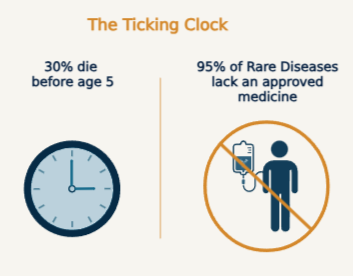
For most of these children and families, the clock is ticking: 30% of children with rare diseases do not survive past age 5. And 95% of rare diseases have no approved treatment.
This crisis stems from the traditional pharmaceutical model, which prioritises a "one-size-fits-all" approach — developing a single drug for millions of patients. Developing new medicines is incredibly expensive, and these traditional models require huge numbers of patients for testing. The uncomfortable truth is that developing drugs for conditions affecting only hundreds of people is simply not profitable. This commercial gap leaves millions of families with nowhere to turn.
A Unique Solution
A radically personalised approach
To treat ultra-rare diseases, we must move beyond the traditional model. The key is precision: targeting the root cause of the condition - the specific genetic error - in each patient, one at a time.
Modern science has given us an advanced genetic "toolbox" to correct these code errors. By applying these scientific tools in a modular, custom-designed way, we can create truly personalised therapies for each unique patient. We call these life-changing interventions: Bespoke Genetic Medicines.
Scaling rare medicines: the platform strategy
We believe the best chance of making life-changing therapies scalable and affordable is by developing modular platforms.
Think of it like a precision construction kit: the universal parts act as reliable foundational elements, designed for safe use across multiple conditions. The only component we customise is the therapeutic payload - the specific genetic code that is precision-engineered to correct an individual's unique error.
This platform-based strategy allows us to rapidly design and scale personalised genetic medicine for multiple rare diseases.
What is Gene Therapy?
Gene therapy is the use of genetic material to treat or prevent diseases.
How it works
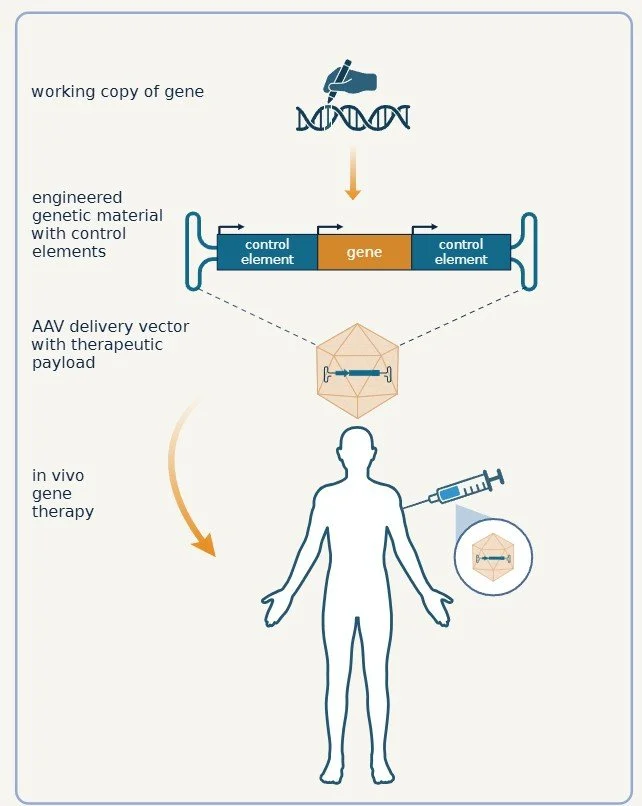
Gene therapy delivers genetic material, such as a working copy of a gene, to change how a protein is produced by the cell. The genetic material is engineered to contain control elements to ensure it is expressed in the right cells. The genetic material delivered to the cell using a vector — think of it as a package with an address label, carrying a specific message for the cells. Typically, inactive viruses, such a adeno associated virus (AAV), are used as vectors because they have evolved to be effective at entering cells.
How it’s delivered
Gene therapy can be delivered in two ways. It can be introduced directly into the patient (in vivo), such as through an injection. Alternatively, a patient's own cells can be removed, the genetic material is delivered to those cells outside the body (ex vivo), and the modified cells are then returned to the patient. The right approach depends on the best way to target the specific disease.
Gene therapy comes with unique risks and challenges that must be carefully considered, along with significant potential benefits. Most gene and cell therapies are currently being studied in clinical trials, which play a vital role in establishing treatments that are safe and effective.